


Lola — The Blade That Learned to Bend
Lola comes from a world that never offered softness, so she learned to make her own. Loss shaped her early, carving out a toughness that isn’t loud but lethal — the kind born from surviving what others don’t talk about. With no family to fall back on and no safety net beneath her, she fought her way through adolescence, literally and figuratively, discovering a talent for combat and a sharper talent for reading danger before it arrived.
Her size made her invisible in all the ways that mattered, and she turned that into power. Lola became the girl who could slip through cracks, gather secrets, and walk away with information worth more than muscle. Years of hustles, fights, and streetwork built her reputation: small, fearless, and impossible to intimidate.
Everything changed the night she stepped into a forgotten building to escape a threat. What should’ve been a hiding place became a turning point — a neglected structure with a strange warmth that felt like it had been waiting for her. She claimed it, restored it piece by piece, and unknowingly set the stage for the life she was meant to build… and the women who would one day walk through its doors.

Molly — The Debutante From Hell
Molly grew up in a world polished to perfection, the kind where appearances mattered more than truth and affection was something performed, not felt. She was raised to be decorative — trained for galas, groomed for status, and expected to follow a script written long before she was born. But beneath the designer dresses and curated manners lived a girl who saw everything: the fear in her mother’s eyes, the control in her father’s voice, the cracks in the family’s perfect façade.
When that world finally turned on her, Molly didn’t break. She walked out. She traded marble floors for cheap apartments, charity galas for city streets, and her father’s expectations for a life she chose herself. Rebellious, curious, and sharper than anyone ever gave her credit for, she built her independence one bold decision at a time.
Her path kept crossing with Lola’s — a small, fierce woman who moved through the city like she owned every shadow. Molly was drawn to her grit, her honesty, her unapologetic language, and the way she handled danger with the ease of someone who’d survived worse. When Lola finally offered her a place in her world, Molly didn’t hesitate. She stepped into the unknown with the same defiant confidence that had carried her out of her old life.
Molly may have been born into privilege, but she became something far more interesting: the debutante who refused the pedestal, the rich girl who chose rebellion over reputation, and the woman who decided her story would be hers alone.

Fannie & Jewel — The Shield and the Light
Fannie and Jewel grew up in a house that looked respectable from the sidewalk but cracked apart behind closed doors. Their father’s temper came in unpredictable flashes, and their mother survived on fear and medication. The girls learned early that safety was something you built yourself, not something you were given.
Born eleven months apart, they became two halves of the same survival instinct. Fannie turned herself into a shield — stepping between Jewel and danger, taking blows meant for her sister, and learning to read violence before it arrived. Jewel became the softer counterweight, the one who still believed in goodness even when the world didn’t offer any. They escaped that house together, but carried its imprint in different directions: Fannie toward stability and a life she could build with her own hands, Jewel toward justice and the police academy, determined to stop men like the one who raised them.
Their adult lives split into two paths — Fannie becoming a brilliant cybersecurity expert with a loving family, Jewel becoming a dedicated officer whose career ended the day she witnessed an unjustified shooting. When tragedy struck Fannie’s home, the sisters collapsed back into each other’s orbit, grief binding them tighter than childhood ever had. And just when their world seemed to be shrinking, Lola stepped in with a card, an offer, and a purpose.
Fannie and Jewel join not because they’re broken, but because they’re built for this — one forged in steel, one anchored in hope, both shaped by a past that taught them exactly what happens when no one steps in.

JoAnne — Innocence Lost In Scars
JoAnne didn’t grow up; she survived. Her childhood was a house filled with fear, a father who crossed every boundary, and a mother who vanished before JoAnne could form a memory of her. She learned early to sleep lightly, lock doors, wedge chairs under knobs, and stay out of reach. By fourteen she was running a household; by fifteen she was running for her life.
She drifted through bus stations, backrooms, and the kinds of apartments where no one asked questions. She learned people by watching them lose — their tells, their panic, their pride — and cards became her first weapon. By sixteen she was sitting in illegal games, reading grown men like open books, and winning pots she had no business touching. When one of those men tried to make her pay for beating him, she answered with the bone‑handled switchblade she’d won earlier that night. It was the moment she realized she wasn’t just surviving danger; she understood it better than the men who created it.
Her path crossed Lola’s in the kind of room where reputations are currency. Lola saw her steady posture, her instinct, her refusal to flinch, and stepped in with a single word that stopped a violent man cold. Later, when JoAnne returned alone from an alley she should never have walked into, Lola didn’t judge, she offered her something she’d never had: safety, a room, and a place where her skill wasn’t a liability but an asset.
JoAnne enters the warehouse wary, guarded, and still half‑feral from the life she escaped. But she’s exactly what the group needs — a fighter with instincts honed by survival, a woman who reads danger like language, and someone who has never once been saved but is finally somewhere she doesn’t have to sleep with a knife under her pillow.
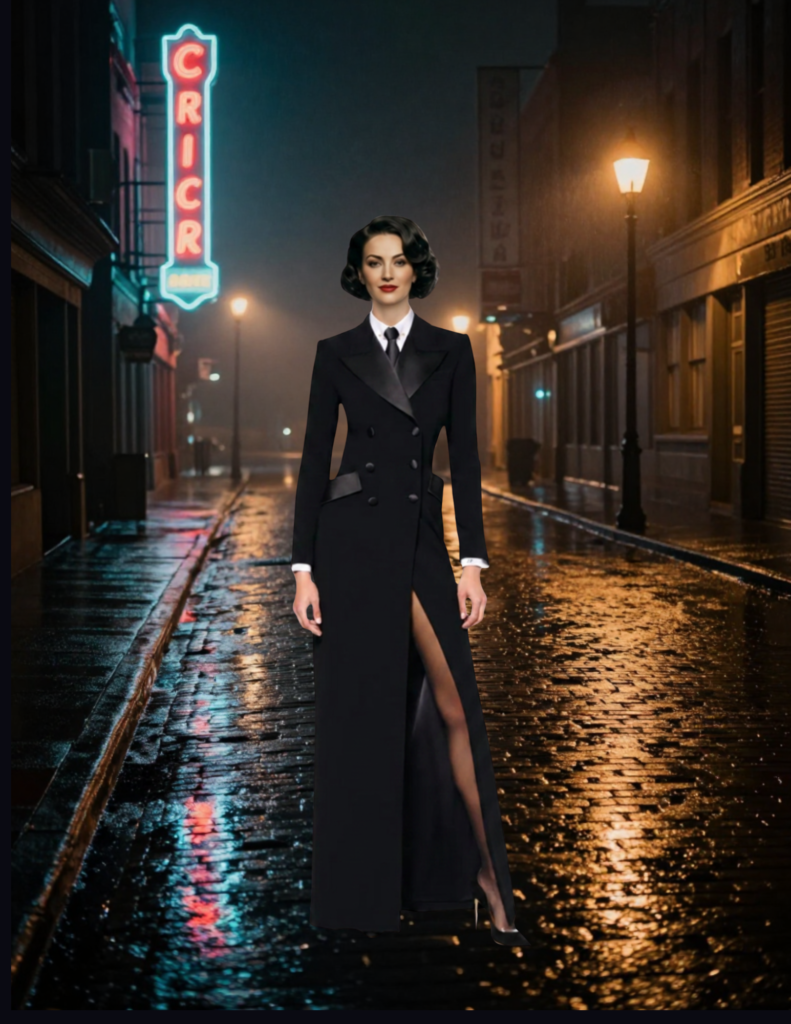
Estelle — The Silent Knife in Silk
Estelle grew up unseen. A child passed through the system without a single person choosing her. She learned early that invisibility could be a shield, and she perfected it — soft voice, light steps, no demands, no trace. While other children clung to hope, Estelle learned to disappear so completely that adults forgot she was in the room. That forgettability became her armor.
When she aged out, she didn’t chase stability. She chased access. Estelle slipped into the upper crust like a ghost — charity galas, private clubs, rooms full of old money and fragile egos. She borrowed names, blended into crowds, and walked away with information worth more than anything she could steal. She wasn’t a thief; she was a phantom. A woman who could sit beside power and leave with secrets no one realized they’d given.
Her path crossed Molly’s on a balcony lit by chandeliers and cigarette flame. Molly saw her immediately — the borrowed identity, the intelligence, the survival written in her posture. She pressed a card into Estelle’s hand, a card that read LOLA in neon scrawl, and Estelle recognized the pattern forming around her: people who should have been broken were strong, people who should have vanished were rising, and they all whispered the same name.
Estelle didn’t chase Lola. She simply appeared where Lola’s world brushed against hers, until the moment Lola finally spoke: “You’re wasted on those people. If you ever want to earn, find me.” And Estelle did. Not because she needed saving, but because she recognized power when she saw it — the kind built in shadows, not spotlights. The kind she was born to move beside.
Together, they formed The Garden……

….not as a refuge, not as a sanctuary, but as a precision-built force born from instinct and experience. Once fully realized, each woman carried a distinct capability — Lola’s fire, Molly’s polish, Fannie’s quiet strength, Jewel’s vigilance, Estelle’s elegant danger, and JoAnne’s unpredictable spark. Individually, they were formidable. Together, they became the kind of unit that steps into the shadows where justice falters and innocence is left unguarded.
As they formed the Garden, their histories sharpened into skill. Their wounds became insight. Their loyalty became law. They learned to move as one — reading danger before it surfaced, dismantling threats without spectacle, and protecting those who never even knew they needed protecting. They weren’t vigilantes. They weren’t saviors. They were fixers, operating in the spaces where truth is fragile and consequences are real.
Fully formed, the women became the Garden’s engine — its strategy, its shield, its quiet, relentless order. They built something beautiful, but never gentle; structured, but never rigid; dangerous, but never cruel. They didn’t become symbols. They became themselves, unfiltered and unafraid, and in doing so, they created a world that exists only because they do.